














The prospect of a low emission zone in Reading has been brought up as councillors have clashed over a controversial cycle lane.
The ultra low emission zone (ULEZ) was first introduced to London in April 2019, and was expanded to all London Boroughs and Heathrow in 2023.
Drivers with more polluting vehicles based on their Euro emissions rating must pay £12.50 daily charge to drive within the zone.
Cities with ‘class D’ clean air zones which charge drivers with non-compliant cars are Birmingham, Bristol and Oxford.
The possible creation of a low emission zone in Reading was mentioned during a debate about the borough council’s Local Transport Delivery Plan.
This is a multi-million-pound plan to make improvements to travel in the town through an application for government funding.
John Ennis, the lead councillor for climate strategy and transport, complained that there is too much “sedentary behaviour” and that active travel measures would alleviate that, but acknowledged the continued necessity to drive.
He said: “Some people, many people, need to drive and many people will have a vehicle, and from time to time they will use it.
“Let’s leave the road to them, and let’s talk about the vehicle that they are driving.
“Let’s ensure that if they are driving on the road, let’s ensure it’s a vehicle that is not having pollutant emissions.”
To that end, measures of the delivery plan include boosting electric vehicle charging, active travel schemes and speeding up bus journeys.
But opposition cllr Dave McElroy criticised the Labour administration for not considering a low emission zone.
He said: “For a moment there, I thought the lead member was going to announce something significant that would influence people’s modal choices some sort of low emission zone or something.
“No, I guess we’ll have to wait for a change of council if we’re hoping to get anything other than more or less more of the same when it comes to transport.”
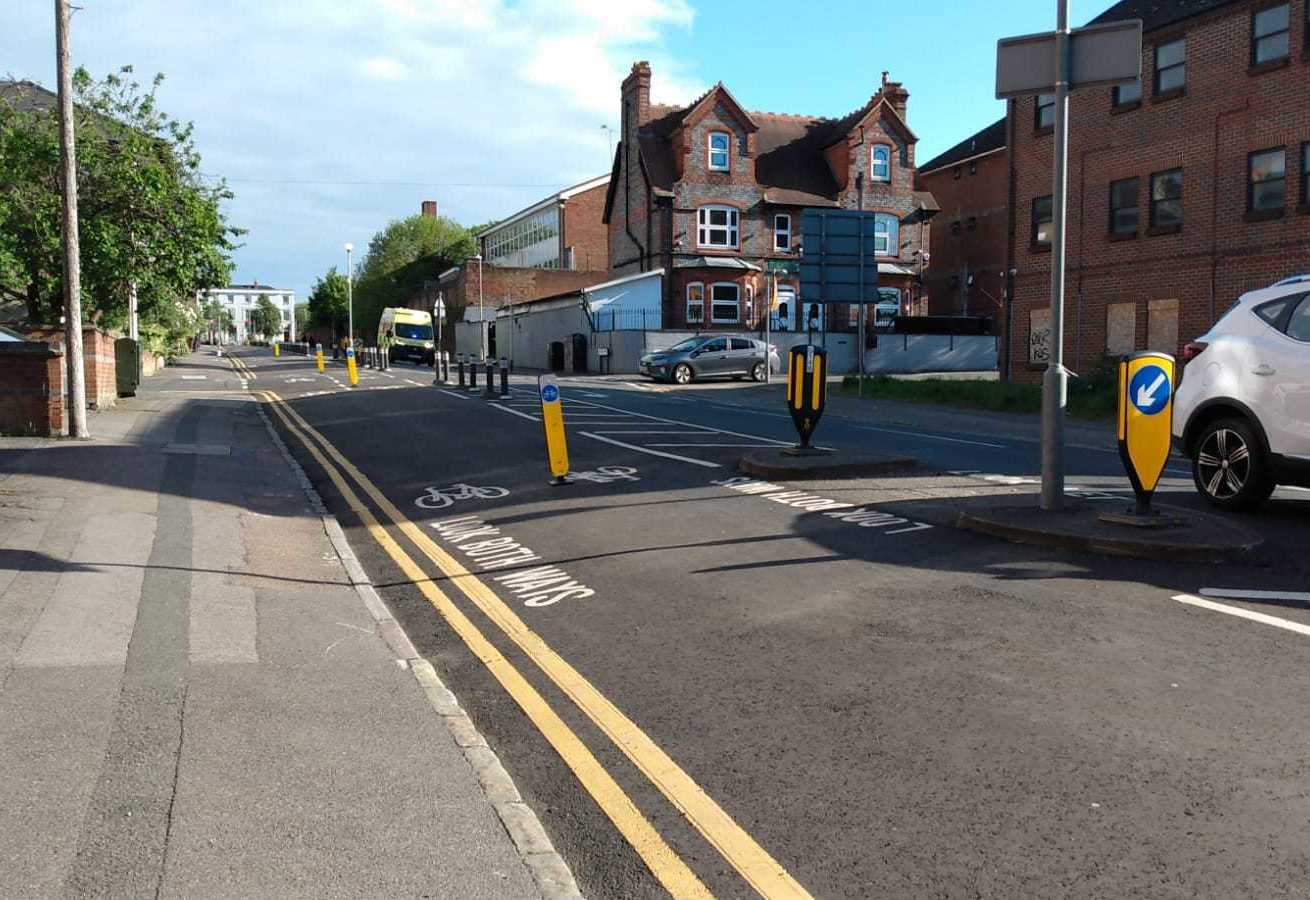
He then called the Sidmouth Street cycle lane the elephant in the room – as a project is being considered to shorten it and create an extra traffic turning lane
Cllr McElroy (Green, Redlands) said: “Obviously, the whole experience we’ve had there has been quite frustrating and disappointing for something to go in, and now for it to be ripped out and replaced with something else.”
He went on to argue that the original scheme was a waste of money and time for council officers.
The cycle lane was created using funding allocated by the Conservative government.
Earlier in the discussion, cllr Will Cross stated that the council had to act quickly to get funding for the scheme through a competitive bidding process devised by the previous government.
Cllr Cross (Labour, Redlands) said: “Some people called it a begging bowl system, some people called it a Hunger Games style system, where local authorities had to rush to put in bids, to scramble against one another and to compete, and the funds allocated in perhaps quite an inconsistent way, which made it difficult for local authorities to be strategic and think long term.
“Sometimes it worked well for Reading, like with the levelling up funds for the library, other times we lost out.
“Particularly in this area of transport, this is a real opportunity for the local authority.”
Cllr Ennis (Labour, Southcote) added: “It was a COVID measure to get people cycling and making sure people were separate.
“We had a vision, we wanted to link it along with other cycle lanes.
“We didn’t get the funding because some political parties are boasting that they are going to take power.”
An initial version of the delivery plan was unanimously approved by the council’s strategic environment, planning and transport committee for submission to the government in March.
A finalised version of the plan will be submitted in September.