



















A fan-led analysis argues Richardson steadied Reading after a difficult start, but questions whether performances and underlying numbers are strong enough to fuel a League One promotion push.
Reading FC supporters are split over whether the club should retain manager Leam Richardson into the 2026/27 season, with a detailed fan analysis highlighting a tension between short-term stability and concerns over style of play and chance creation.
How the debate started: new owners, higher expectations
Twelve months ago, Rob Couhig and Todd Trosclair completed a takeover of Reading FC, a move widely welcomed by supporters who say the new ownership has brought greater stability after a turbulent period.
Going into 2025/26, many fans set their sights on consolidation and rebuilding, viewing a play off challenge as an upside rather than a minimum requirement.
Against that backdrop, a top-half finish would represent progress for some — but others argue the squad and budget should point higher.
One flashpoint was the summer transfer window. The analysis argues the club moved too slowly for late-market value deals, leaving then-head coach Noel Hunt with a thin squad and limited time for new arrivals to bed in.
Reading’s early-season slump in August and September dropped the side into the relegation places. Many supporters, the author says, did not primarily blame Hunt, believing circumstances made the opening weeks especially difficult.
As an example, the analysis notes striker Jack Marriott was available for only eight of the 14 matches Hunt oversaw.
It also argues defensive continuity was hard to find: the first time O’Connor and Williams started together — described as the strongest centre-back pairing — was not until the 13th match of the season. Hunt was replaced after 14 games, a decision some fans now view as premature.
Richardson’s results: safety first, but questions over style
Richardson took charge and, the analysis says, achieved the immediate objective of pulling Reading away from relegation trouble. But it argues the wider mood has remained unsettled, with many fans unconvinced the current approach will translate into a sustained promotion challenge.
Much of the criticism centres on tactics and entertainment value. Supporters describe the football as cautious and point to shot and expected-goals indicators in the fan report as evidence Reading are not consistently creating enough to dominate matches.
Online discussion and supporter debate has increasingly focused on whether Richardson is the right fit for the club’s next phase. The analysis warns that, without clearer signs of attacking progression, some fans could disengage — a dilemma for the board as it weighs continuity against a fresh start.
Why some want to keep him
• He has previously won promotion from League One with Wigan, and supporters in his corner believe he can replicate that with a squad shaped in his image.
• Changing manager can be expensive, and some argue the club’s resources would be better spent strengthening the squad.
Why others want a change
• Critics argue the approach is too conservative and fear attendances could suffer if results and entertainment do not improve.
• Richardson has spoken about needing “three to four transfer windows” to reshape the squad; some supporters view that timeline as too slow, saying they want a team capable of competing near the top next season.
• The report also criticises aspects of Richardson’s post-match messaging, including what it describes as an incorrect reference to a 50% win rate after the Huddersfield. In 70% of his matches in charge the opposition have recorded more shots than Reading.
• Those calling for change argue a more progressive, attack-minded appointment could lift performances and improve the matchday experience — and that any promotion bid will require a clear shift in underlying numbers as well as results.
What the numbers suggest
Hunt v Richardson: results against the same opponents
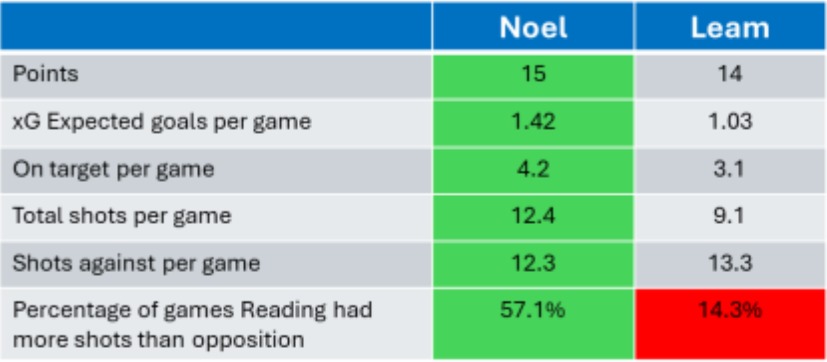
Hunt led the side for the first 14 league matches. The fan report compares those fixtures with Richardson’s results against the same 14 opponents, using points alongside shot and shots-on target totals.
On that like-for-like comparison, the author argues Hunt fared better across each headline measure: more points, more shots, more shots on target and fewer shots conceded. The report highlights shot share as a key concern, stating that under Richardson Reading outshot the opposition in only two of those 14 matched fixtures (14%), compared with 57% under Hunt.
The analysis also says Hunt’s early-season figures came in difficult circumstances, including limited availability of key players and late reinforcements:
• Marriott was available for eight of the 14 games.
• The preferred centre-back pairing of O’Connor and Williams, the report says, started together only twice in that period.
• Six players listed in the report were not available during Hunt’s spell because they arrived later or were unavailable.
Among the headline points, the author highlights a negative balance between shots for and shots against, arguing teams rarely win promotion while being outshot consistently and that Reading would need a major shift to challenge at the top of League One.
The report also points to an average of 3.8 shots on target per match as an indicator of a limited attacking output.
Across the 30-game sample, it says Reading recorded more shots than the opposition in only 30% of matches.
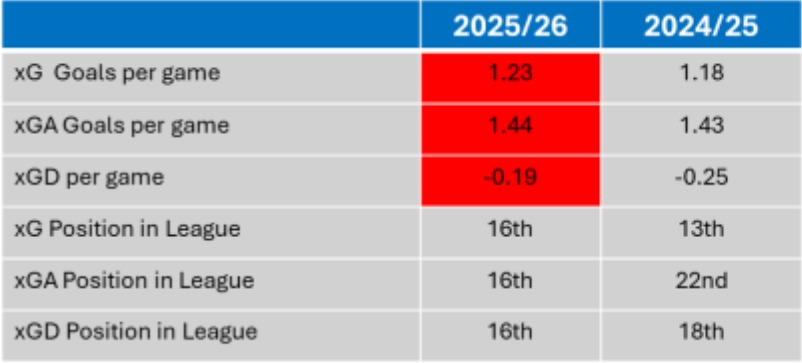
On expected goals, the document states Reading rank 16th in League One for xG and have a negative expected goal difference (xGD). It adds that those averages would be lower if the opening 14 games under Hunt were excluded, arguing Hunt’s spell lifts the overall baseline.
In conclusion, the author argues Reading must generate more shots while conceding fewer to mount a promotion challenge, and questions whether Richardson’s current tactical approach can deliver that turnaround. Richardson’s points tally is misleading and flatters to deceive as many games were won by scoring with virtually every shot, thanks mainly to Jack Marriott’s conversion rate. It is also worth noting that the away fans have commented in many matches that Reading were the worst team they had seen all season and questioning how Reading could be challenging for a play-off place.
This season versus last: little movement, big questions
The analysis argues Reading are likely to finish lower than last season, despite the instability that surrounded the club a year ago. It says the year-on-year comparison shows limited change across key indicators, and that a negative xGD and a ranking of 16th for xG underline the scale of improvement required to push for promotion. The report frames the decision for the club as whether to back Richardson to drive that change, or act now to appoint a coach more aligned with a front-foot style.
With the summer window approaching, the debate is likely to intensify as Reading’s board weighs managerial continuity against the appetite among most of the fanbase for a more expansive identity, and as recruitment plans for 2026/27 come into sharper focus.