


















Councillors have debated changes to a controversial cycle lane in Reading that would provide more space for drivers.
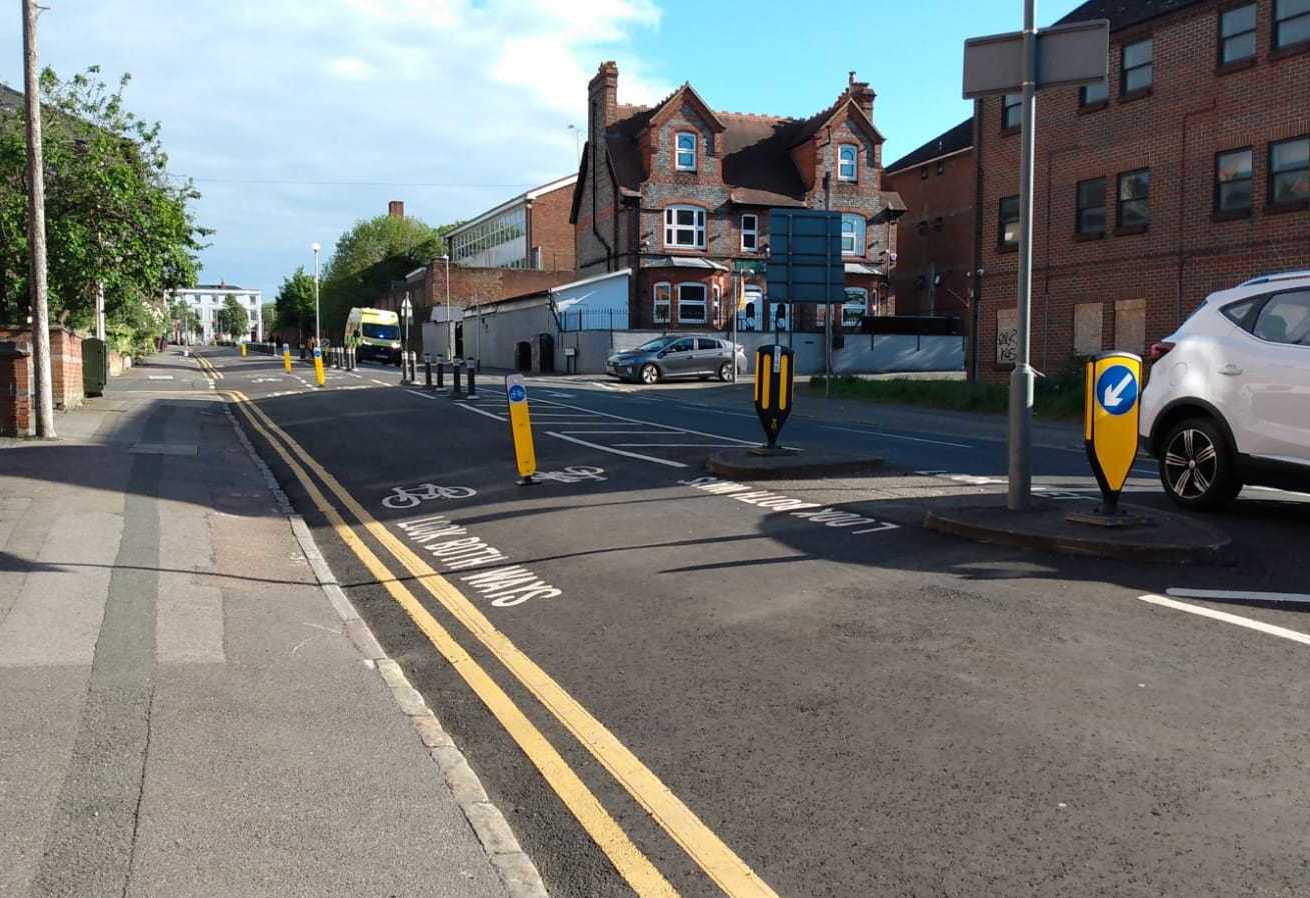
Cycle lanes have been established in Sidmouth Street since 2020, when Reading Borough Council was given funding from the previous Conservative government to enhance active travel during the coronavirus pandemic.
Controversially, the project took away the southbound lane of the street for drivers, creating a two-way cycle lane instead.
Highways officers have explored options to improve journeys in the street.
The favoured option involves ending the cycle lane at the junction with South Street, and using space to provide an extra eastbound turning lane at its junction with Queens Road.
There is currently a single turning lane for both directions at that junction.
A decision to consult on the reduction of the cycle lane was made at a meeting of the council’s traffic management sub-committee.
James Clements, a transport programme manager, explained that a southbound cycle lane, going up the hill, would be retained.
John Ennis (Labour, Southcote), lead councillor for transport, explained that a vision to link it up with other cycle routes has been stunted due to a lack of further government investment.
He said: “That didn’t happen, and we have to be honest, that cycle lane is underutilised.
“And many people said that, they did. But a bold vision does need to be created.”
Cllr Ennis advocated for the redesign to speed up journeys for drivers and enable the creation of a bus lane in London Road.
Rob White, the leader of the opposition, was the only councillor who voted against making the cycle lane permanent in September 2022.
He said: “Reading is a compact town, it should be amazing for cyclists, you should be able to get from one side to the other quicker than by almost any other mode of transport.
“But we all know the problems, the cycle network isn’t joined, it’s fragmented, it needs to be joined.
“I cycle multiple times a week, I cycled in via Sidmouth Street, as usual, I was the only cyclist on the lane.
“Greens want to see decent cycle infrastructure and more of it, but this is neither, that’s why it’s poorly used.
“Greens want to build support for good quality cycle infrastructure, but bad cycle infrastructure like this just gives the bike haters more ammunition, unfortunately.”
He went on to say Greens were never convinced by the cycle lane, as it duplicates the route at Watlington Street.
Cllr White (Green, Park) also mentioned that a bid to improve the junction of Sidmouth Street and Queens Road would cost a ballpark figure ‘something north of half a million pounds’.
He suggested the council should have bid for other cycle infrastructure improvements.
Earlier, cllr Ennis praised cllr Will Cross (Labour, Redlands) for pushing for the investment into changes at that junction.
However, the council failed to receive the money required in the Active Travel Fund 4, making the project undeliverable.
Cllr Adele Barnett-Ward (Labour, Thames) stressed that the council had to fulfil specific criteria to get funding to deliver the active travel projects in 2020.
She said: “We started to look at schemes, and the hoops we had to jump through were ridiculous, and it was very difficult to get the money spent.
“One of the things you had to do is take roadspace from cars, and reallocate it to active travel, and that knocked out a whole load of things we could’ve done that would have improved getting around for pedestrians and cyclists in the town.
“We’ve always had the principle on the Labour side that if we can get investment for Reading, we will. So we put together schemes we knew would be approved.”
She did jab cllr White for suggesting that cyclists only want to use Watlington Street as ‘one link’ to the cycle network, calling it “mad”.
Councillors unanimously agreed to enter into a statutory consultation to make the changes at the meeting on March 5.