
















A MUSICIAN from Reading and his best friend have managed to escape from Dubai, having been trapped in their hotel while missiles rained down outside.
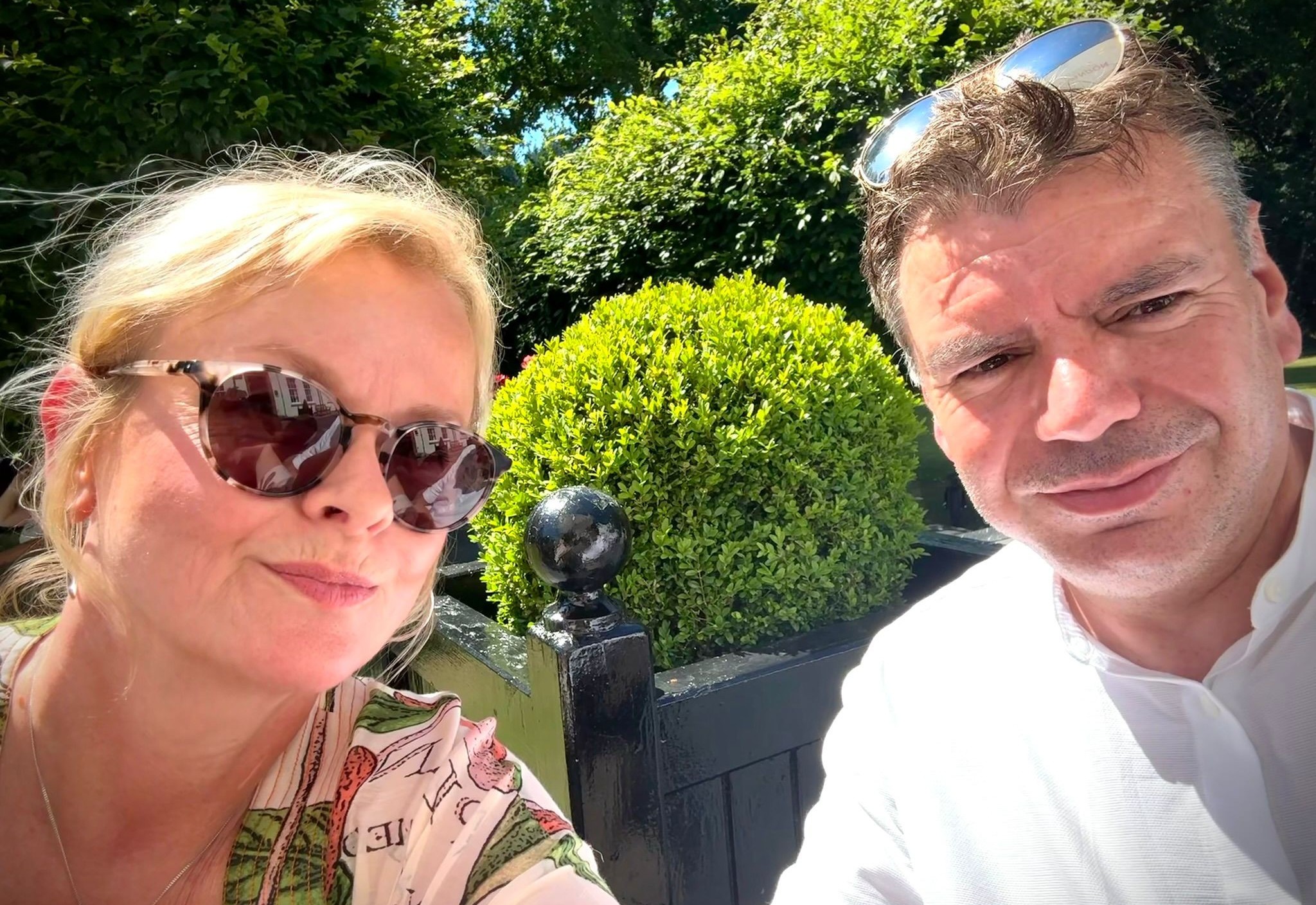
John Mitchell, a guitarist with band Asia, and his best friend Sarah Ewing, found themselves in a warzone when they took a 10 day break in the United Arab Emirates (UAE).
“We’re OK,” said John, “but it’s been extremely stressful, and a long and complicated journey.”
After a tough year, Sarah decided they should both take a short holiday.
Arriving at the The Palm in Dubai, however, they were able to enjoy just one day of their vacation.
Sitting on sunloungers on the second day they noticed a loud sub-boom.
“It sounded like construction and we heard it a few times,” said John.
“We knew Donald Trump had attacked Iran, 150 miles away across the water, but it seemed relatively distant.”
But a nearer blast sent them inside, and more explosions followed.
That night the hotel community slept under beach towels in the window-less ballroom for safety.
“It was absolutely terrifying – the whole hotel was shaking,” said John.
“Burning debris fell from intercepted missiles, setting things alight.
“It was very, very frightening indeed.”
Despite the UAE government telling people not to worry, its social media posts warned posting false information risked prosecution or jail.
“It was Orwellian,” said John.
“Leaving Dubai was incredibly difficult; they immediately shut down the air space above UAE.”
When the UK Government planned to repatriate people, John and Sarah signed up.
“Emails and texts from them said: ‘we know how difficult this must be; just stay put,” said John.
“But there was no information; it was all very woolly.
“We remained as long as we dared, but then I began to think we should get to Oman.”
A few nights later a huge explosion close to the hotel made the decision for them.
“We thought our bedroom window was going to blow in, and Sarah said to me: ‘That’s it, we’re leaving,’ ” said John.
Drivers were reluctant to take them to the Oman border, but a friend they had made agreed to drive them in his taxi.
HTo enter Oman they learned they would need to be booked onto an onward flight, so the pair searched for options.
“We just wanted to go East, anywhere away from the Gulf,” said John.
In great haste they booked a flight to Mumbai.
“It might seem extreme, but at least it was out of the war zone,” he said.
After a four hour drive they were dropped off at Border Control.
“It was very strange, a kind of ravine in the desert, with barbed wire,” said John.
“But they stamped our passports and hurried us onto a night coach to Muscat Airport.”
Booking into a nearby hotel to wait for their Mumbai flights they discovered they didn’t need an onward flight after all.
And alarmingly, they also discovered they needed visas to enter India, so an urgent visit to the Indian embassy in Muscat was required.
“Lovely people there turned our visas around in a day, so very early the next morning we were able to jump on a flight to Mumbai,” said John.
Sarah says that UK Foreign Office communication has been very poor.
Most messages from them were along the lines of: ‘We’re thinking about you,’” she said.
“But one told people fleeing to Oman to re-register – so I did.
“Ten minutes later I got a text offering us a place on the first repatriation flight from Oman to the UK, for £350 each.
“I said to John we’d be stupid not to go for it, so we registered and paid – we were desperate and just wanted to go home.”
But the receipt said a seat wasn’t guaranteed, and they waited all day for confirmation.
An hour before take-off they had still heard nothing.
“Foreign Office communications have been appalling,” said Sarah.
“It shouldn’t be that difficult to tell people who are already in a state of panic: ‘don’t worry, you haven’t made this flight, but we’ll get you on the next one, or, you can apply for a refund.’
“What people need more than anything else is information.
“You need a plan of action to help alleviate the anxiety, but there was nothing.”
“It was radio silence,” agreed John.
“At one point we even thought the flight was a scam.”
Returning to plan A, the friends flew to Mumbai.
“The minute the tyres hit the tarmac we got a call from the Foreign Office asking us if we wanted a flight – it was unbelievable,” said John.
In their Mumbai hotel they searched for a route home.
The only option earlier than three weeks and costing less than £8,000 was a complex schedule involving five countries.
John and Sarah’s 10 day holiday had become a world tour: Mumbai to Mauritius, Mauritius to Johannesburg, Johannesburg to Angola, Angola to Lisbon, and Lisbon to Luton.
“It was our only way home, but here’s where it gets absolutely insane,” said John.
“Our flight from Mumbai airport was delayed, so, arriving at Mauritius we grabbed our bags and ran with them to the South African Airlines gate for the next flight to Johannesburg.
“They were really nice, gave us seats together, checked in our bags, then asked for our passports.
“Then came the real kicker.
“I play guitar with the band Asia, and travel a lot, so my passport is filled with visas.
“The lady took one look at it and said: ‘I’m sorry but you can’t fly to South Africa – you haven’t got two blank pages on your passport.’
“The whole journey was scuppered.”
Sarah added: “By this time my eyes had welled up, and I said: ‘look, we’ve escaped from Dubai, we’ve had a horrible, frightening experience and we just want to go home – can’t you do anything to help?’
“But she said there was nothing she could do.”
Retrieving their bags from the plane in the nick of time they booked into a Mauritius hotel, where Sarah tried to cancel the remaining flights, and John searched for another way home.
Discovering a flight to Gatwick, he grabbed it.
“There goes another £2,000,” he said.
“The whole trip has cost somewhere between £8,000 and £10,000 of savings, which, you know, not everyone has.”
Worried John’s passport might prevent him flying to the UK, the pair went to the British Consulate in Mauritius for advice.
They received no help at all.
“They wouldn’t speak to us,” said Sarah.
“When they said they were too busy I just lost it.
“We’d been through so much, and we were both really fried.
“I said: ‘We’re British citizens trying to get home from a war zone.’
“But, no, they were too busy.
“We all expect that when we’re abroad, a British Embassy will help us, but we’ve just proven that’s not true.”
“In the end we asked Air Mauritius staff about my passport – who went out of their way to check and reassure me,” said John.
“In all of this it’s the locals who have helped us; taxi drivers, a friend we made in Muscat who checks in on us daily; and people on the ground who’ve been incredibly kind.
“The only people who haven’t helped us are British people.
“Virgin Airways, and Love Holidays aren’t at all interested.
“I have a lot of Virgin Air Miles, but the company has realised it can monetise this situation, has capped them and won’t let people use them to get home.”
But in the face of their ordeal, the friends are choosing to focus on positives.
“This has been really distressing,” said Sarah, “but one thing I’ve learnt is that despite language and cultural differences, humanity and goodness is out there, and people will help you.
“With all the bad things that are happing in the world, it’s lovely, and reassuring, to know that.”
John and Sarah are currently waiting in Mauritius for their flight home on Friday.
“It’s beautiful, an incredible island,” said John, “and we’ll enjoy the next few days here.
“We set out to go to Dubai, but we’ve inadvertently taken a holiday in beautiful Mauritius.”
Dubai has seen a rapid spike in danger as the result of escalating hostilities between the USA, Israel, and Iran in recent weeks, with Dubai suffering direct attacks from Iranian missiles and drones.
Among targets hit were Dubai International Airport and a number of luxury hotels.
It comes as the result of surprise military operations launched by the US late last month, when it coordinated an attack with Isreal on Iran.
More than 2,000 strikes were launched against Iran in the first two days of the operation, resulting in the death of Iran’s Supreme Leader, Ali Khamenei.
In response, Iran has launched a number of retaliatory strikes against neighbouring countries which hold American military bases and infrastructure, including Dubai.
On Monday, March 9, the UAE’s National Emergency Crisis and Disasters Management Authority (NCEMA) issued fresh alerts as air defences responded to a new wave of incoming missile threats.
While airports in Dubai are technically open, they are operating under emergency protocols, with Dubai International (DXB) and Al Maktoum International (DWC) resuming operations over the weekend, but under considerable restrictions.
Multiple foreign airlines have suspended routes including Dubai for the forseeable future, and countries including Australia and New Zealand have placed the region under Do Not Travel orders.
The UK government currently advises that only the most essential travel to Dubai should be undertaken, and has begun organising repatriation efforts.